
Black & White Photography Prints
Black and white photography is not simply colour photography with the colour removed. I use monochrome when colour is no longer essential to the image and when shape, light, texture, contrast, or atmosphere can become stronger without it.
This collection of black and white photography prints includes minimalist landscapes, mountains, architecture, botanical forms, trees, animals, abstract photography, and quiet natural details. Some images were conceived as black and white from the beginning; others became monochrome because colour distracted from what I wanted the photograph to express.
I am especially drawn to scenes where a limited tonal range helps simplify the image — fog, snow, silhouettes, dark architecture, isolated natural forms, and subjects built around strong lines or negative space.
Showing 1–54 of 166 results


Why I Photograph in Black and White
I do not think black and white automatically makes a photograph more artistic or more timeless. For me, the decision is much simpler: does colour contribute something important to the image?
If colour carries the atmosphere, separates important forms, or is itself the reason I noticed the scene, I usually keep it. But when a photograph is mainly about shape, light, texture, space, or tonal relationships, colour can become unnecessary information.
Removing it can make the photograph more precise. A red wall and a green tree are no longer primarily red and green; their relationship depends on brightness, contrast, shape, texture, and position within the frame.
This is especially important in my Minimalist Photography Prints, where reducing information often gives the remaining elements more visual weight.
Black and white is not, however, my default solution for a photograph that does not work in colour. If the underlying composition is weak, removing colour usually will not save it. In many cases I recognize while photographing that a scene is primarily about tone rather than hue; in others, the final decision comes later while editing.
Black and White Versus Colour
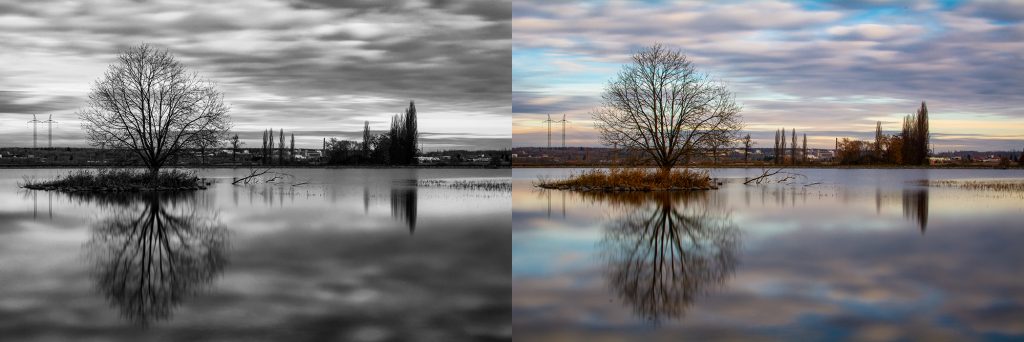
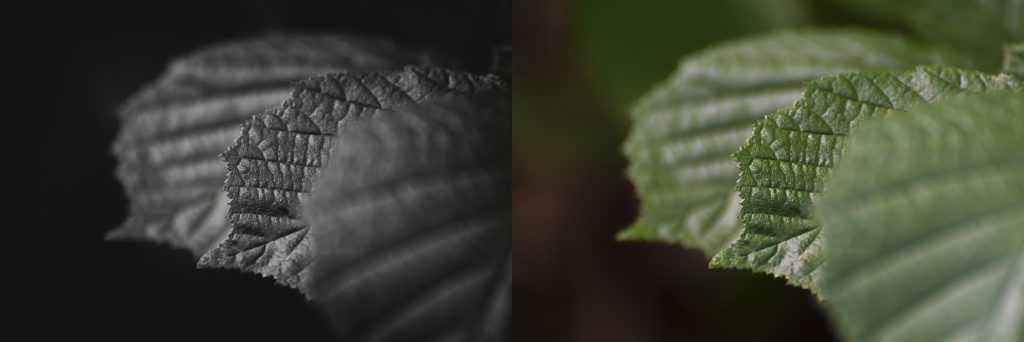
The same photograph can communicate something quite different when colour disappears.
Colour provides immediate information about season, weather, materials, and location. Black and white can weaken those literal clues and move attention toward structure, light, rhythm, and atmosphere.
The examples below show the same scenes in colour and monochrome. I do not consider one version automatically better. The choice depends on what I want the photograph to be about.
Subjects I Photograph in Black and White
My black and white work moves between landscapes, architecture, plants, natural forms, and abstraction. The subjects are different, but monochrome often serves the same purpose: it removes one layer of information and makes the underlying structure of the photograph easier to see.
Mountains, Winter and Quiet Landscapes
Mountains are among the subjects where black and white feels most natural to me. Snow, rock, cloud, and fog already create a limited palette, so removing the remaining colour allows me to concentrate more directly on ridges, layers, texture, scale, and atmosphere.
I particularly like mountains in poor visibility. Cloud may hide most of a peak, snow can merge with the sky, and only one dark fragment remains visible. The photograph becomes less descriptive and more concentrated.
Winter works in a similar way. Snow removes detail from the ground, trees become dark lines, fog weakens the background, and frozen water turns into broad pale areas. You can explore more natural monochrome work in my Black & White Nature Photography Prints, Mountain Photography Prints, and Winter Photography Prints.
Architecture and Geometry
Architecture is another subject where colour can easily become secondary. Concrete, repeated windows, staircases, façades, shadows, arches, and silhouettes already provide strong structural relationships.
In black and white, a building can become less about material or location and more about geometry. This is particularly useful with architectural fragments and images where strong light divides a surface into simple areas of brightness and shadow.
For related work, explore my Architecture Photography Prints and Geometry Photography Prints.
Botanical and Natural Forms
Plants and small natural objects can change dramatically in black and white. A stem becomes a line, a dry flower a tonal structure, and leaves can be reduced to rhythm and repetition. Shells, mushrooms, stones, and other natural forms often reveal texture and geometry more clearly when colour disappears.
This is particularly important in some of my in-camera multiple-exposure botanical photographs, where repeated stems and curves create complex structures. Monochrome allows me to concentrate more directly on gesture, movement, and form.
See more in my Botanical Photography Prints, Organic Shapes Photography Prints, and the Botanical Gestures series.
Abstract Black and White Photography
Monochrome also plays an important role in my abstract work. When colour disappears, a photograph can depend almost entirely on rhythm, movement, contrast, and shape.
A forest can become vertical bands, a building an unstable grid, or a plant a sequence of overlapping gestures. Techniques such as Intentional Camera Movement and in-camera Multiple Exposure can push the image even further away from straightforward representation.
Explore more in my Abstract Photography Prints.
Light, Tone and Negative Space
One reason I return to black and white is that it makes the structure created by light easier to see. A narrow band of sunlight across a wall, a pale object emerging from darkness, or a silhouette against fog can become the entire composition.
This does not mean that monochrome photography needs extreme contrast. Some of my favourite black and white photographs contain only subtle differences between pale grey, white, and almost invisible forms. What matters is the relationship between tones rather than the amount of contrast itself.
Black and white also works naturally with the negative space I often use. Fog, snow, sky, water, or a simple background can surround a small subject with very little visual information. Without colour, that empty area can become even quieter.
A lone tree, mountain peak, bird, plant, or architectural detail may gain more presence precisely because there is so little competing with it. For me, emptiness is not the absence of composition; it is often one of its main elements.
Choosing a Black and White Photography Print
Because this collection includes many different subjects and photographic approaches, I would choose a print according to its visual character rather than simply because it is monochrome.
- Minimalist black and white photographs with large areas of negative space tend to feel quiet and visually light.
- Mountain and landscape photographs can create a stronger sense of depth and atmosphere, particularly at larger sizes.
- Architectural photography tends to feel more geometric, graphic, and structured.
- Botanical and organic forms introduce softer curves, natural irregularity, and more intimate detail.
- Abstract black and white photography works well when the image should be experienced primarily through shape, movement, rhythm, or contrast.
Scale also changes how a photograph works in a room. A simple image with a clear subject or strong negative space can often be enlarged considerably without becoming visually overwhelming. A highly detailed or high-contrast photograph will usually have a stronger presence at the same size.
For a more detailed look at scale and placement, read my guide to Large Black and White Photography Prints.
If you already know that you want the photograph framed, see my Framed Black & White Photography Prints guide, where I compare black, white, silver, and wood frames as well as matting options for monochrome photography.
Printing, Framing and Delivery
Individual photographs are available in different sizes and print formats. Choose a photograph from the collection above to see the current options available for that particular image.
If you want to compare different ways of presenting photography, including paper, frames, canvas, metal, acrylic, and wood, see my main Fine Art Photography Prints page. You can also read the more detailed Framed Photography Prints guide.
For current fulfilment and delivery information, see Shipping Information. Orders are also covered by the 30-Day Money Back Guarantee.
Frequently Asked Questions About Black and White Photography Prints
Why do you photograph in black and white?
I use black and white when colour is not essential to the photograph and when shape, light, texture, tonal relationships, or atmosphere become more important without it. I do not convert every photograph to monochrome automatically.
Do you decide on black and white before taking the photograph?
Sometimes. Certain scenes already appear primarily as tonal relationships to me, particularly snow, fog, strong shadow, architecture, and minimalist compositions. In other cases I make the final decision while editing.
What subjects are included in this collection?
The collection includes landscapes, mountains, architecture, botanical forms, trees, animals, abstract photography, shells, water, winter scenes, and other natural and urban subjects.
Do black and white prints work in colourful interiors?
Yes. Because monochrome artwork does not introduce another dominant hue, it can work with many existing colour palettes. Scale, contrast, visual density, framing, and the mood of the photograph are usually more important than the colours already present in the room.
Where can I find more minimalist black and white photography?
Explore my Minimalist Photography Prints, Black & White Nature Photography Prints, and Abstract Photography Prints for related work.