
Mongolia - Fine Art Photography Prints
Mongolia is one of the places that has influenced my photography most deeply. I first came to the country through my studies of Mongolian Studies and later returned many times, travelling through its deserts, steppes, mountains, lakes, monasteries, and remote settlements.
This collection of Mongolia photography prints includes the Gobi Desert, Lake Khovsgol, yurts, Buddhist statues and stupas, modern architecture, solitary trees, sand dunes, and wide open landscapes.
I am less interested in presenting Mongolia as an exotic travel destination than in the visual qualities that keep bringing me back to it: enormous space, sparse human presence, simple forms, silence, weather, and the relationship between people and landscape.
Showing all 29 results


Why Mongolia Became Important to My Photography
My relationship with Mongolia began long before I thought about it as a photographic destination. I studied Mongolian Studies and spent a significant amount of time in the country, later returning repeatedly and travelling through very different parts of it.
That changes the way I photograph there. Mongolia is not simply a place I visit in search of spectacular scenery. It is a landscape I know well enough to be interested in quieter details: one tree in an enormous plain, the shape of a ger against the horizon, a bench beside a lake, a line of stupas, or a dark volcanic rock illuminated for only a few minutes by changing light.
Over time, Mongolia became closely connected to the way I think about landscape photography and minimalist photography.
Space Is One of the Main Subjects
Mongolia is often described through its vastness, but that scale is difficult to communicate in a photograph.
For me, one of the best ways is not to fill the frame with dramatic scenery, but to do the opposite. A tiny tree, a distant ger, a person on a dune, or a small building surrounded by empty land can make the space around it feel much larger.
This is why many of my Mongolian photographs contain generous areas of sky, steppe, sand, or water. The apparent emptiness is not unused space. It is part of the subject.
Photographs such as Lone Tree in the Gobi Desert, Yurt in Mongolia, and Silhouettes of People on a Sand Dune all use scale in this way.
The Gobi Desert Is Not Only Sand
The Gobi is sometimes imagined as an endless landscape of sand dunes, but much of it looks very different. There are rocky plains, dry valleys, grasslands, cliffs, mountains, isolated settlements, and enormous stretches of almost empty terrain.
That diversity is important photographically. Some places offer strong texture and detail, while others are so visually sparse that a single object can dominate the entire image.
Sand dunes are especially interesting because wind constantly redraws their surfaces. From a distance, a dune may appear as a simple curve. Closer up, small ridges and shadows create patterns that can become almost abstract.
You can see this in the photographs Sand Dunes in Mongolia and Sand Dunes Up Close, where the same kind of landscape works at two completely different scales.
For related work based on shape and reduction, explore my Abstract Photography Prints and Organic Shapes Photography Prints.
Gers, Nomadic Life and the Landscape
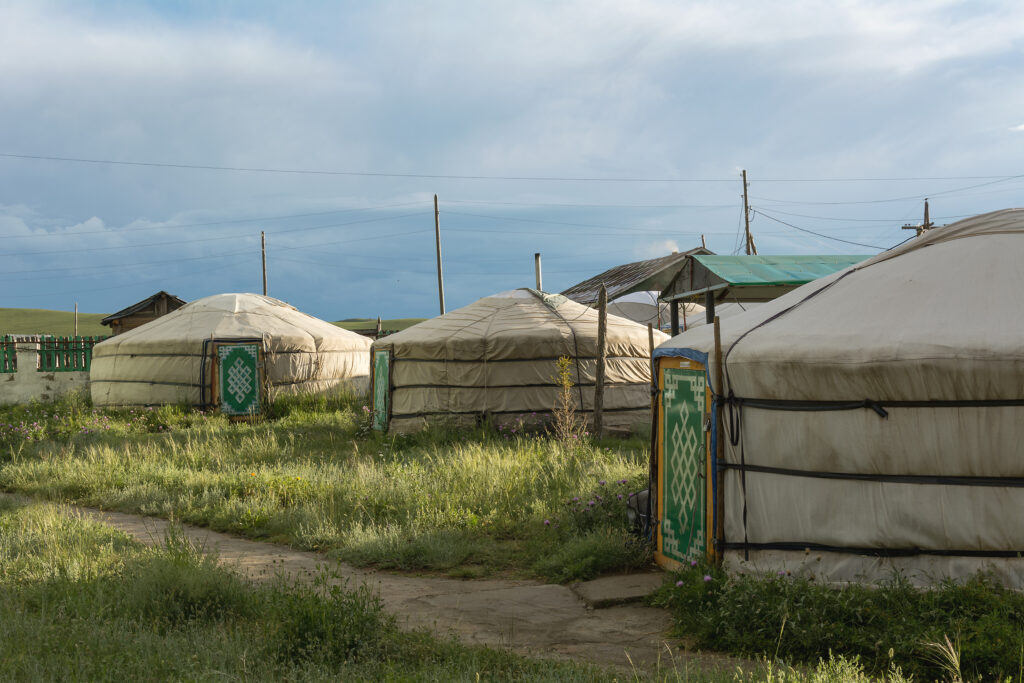
The traditional Mongolian ger — often called a yurt in English — is one of the most recognizable forms in the country, but what interests me photographically is often its relationship with the surrounding land.
A ger is simple in shape: low, circular, white, and visually very different from the horizontal steppe around it. In an open landscape, even a very small ger can become an important compositional point.
At the same time, I try not to treat nomadic life simply as a picturesque symbol. Gers are homes, and the landscape around them is part of everyday life rather than a scenic backdrop created for photographers.
This distinction matters to me. I want the photographs to retain some of the quietness and normality of these places rather than turning every encounter into an exotic spectacle.
Lake Khovsgol: A Different Mongolia
Northern Mongolia feels completely different from the Gobi.
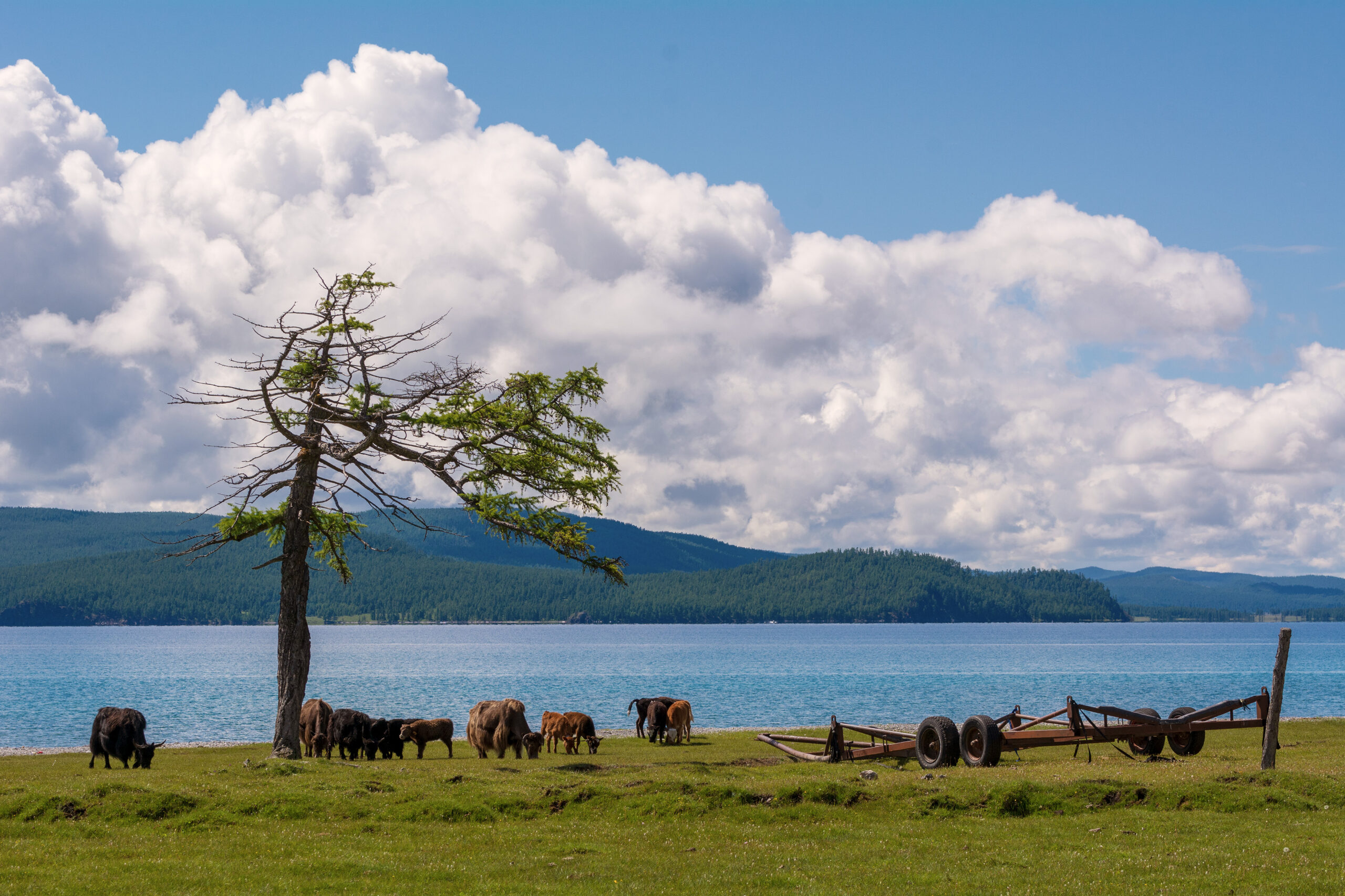
Lake Khovsgol is surrounded by forests and mountains, with cold clear water and rapidly changing weather. Photographing there gives me a very different visual vocabulary: reflections, dark water, distant shorelines, mist, trees, and subdued colour.
Several photographs in this collection deliberately avoid the classic picturesque view of the lake. In some, Khovsgol becomes almost monochrome or grainy; in others, a simple bench on the shore becomes the main subject.
I like these photographs because the famous landscape becomes quieter and more personal. A small human object can sometimes say more about being beside an enormous lake than another wide panoramic view.
You can find related photographs in my Water Photography Prints and Reflection Photography Prints.
Buddhism and Sacred Forms
Buddhism is another visual layer of Mongolia that has repeatedly entered my photographs.
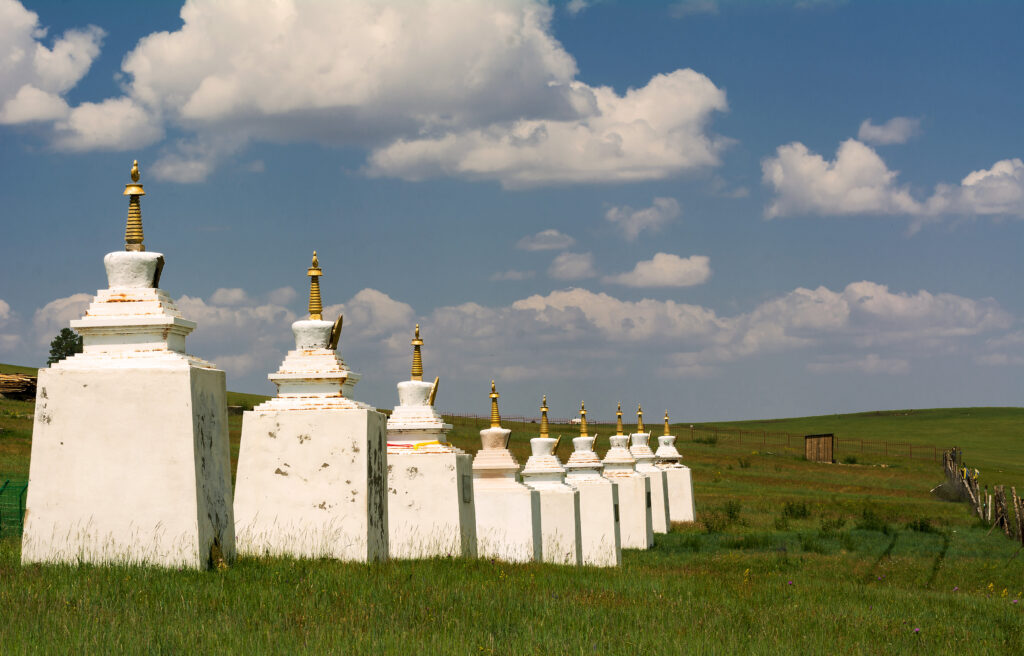
Stupas, statues, temples, prayer flags, and monastery architecture introduce very different colours and forms from the surrounding landscape. Gold, red, white, and blue can appear suddenly in places otherwise dominated by earth, grass, rock, and sky.
I am interested not only in the religious meaning of these objects, but also in their visual presence: repeated stupas, the symmetry of a Buddha statue, weathered surfaces, and the contrast between sacred architecture and enormous open space.
Photographs such as Golden Buddha, Colorful Buddha, and Buddhist Stupas in Mongolia represent this side of the collection.
For more related work, explore my Religion Photography.
Modern Mongolia Also Belongs in the Picture
I do not want my photographs of Mongolia to suggest that the country consists only of yurts, monasteries, and untouched landscapes.
Mongolia is modern as well as traditional, and some of the photographs in this collection deliberately include contemporary architecture and unexpected structures.
Desert House and other modern buildings photographed in the Gobi interest me precisely because they disrupt the image many people expect from Mongolia. Clean geometry appears in an almost empty desert environment, creating a strange relationship between architecture and landscape.
This overlap between built and natural space connects with my Architecture Photography Prints and Geometry Photography.
Weather Can Change Everything
Despite the apparent openness of the landscape, conditions in Mongolia can change surprisingly quickly.
Strong wind, dust, clouds, rain, and sudden evening light can completely transform a place that looked visually unremarkable only minutes earlier.
Clouds Over the Rock is one example. Near Terkhiin Tsagaan Nuur, evening sunlight briefly illuminated clouds rising behind a dark volcanic rock. The important part of the photograph was not the famous location itself but the short-lived relationship between light, cloud, and stone.
This is one reason I am wary of planning landscape photographs too precisely. I can choose where to be, but often the photograph appears only when the place gives me something unexpected.
More work shaped by changing weather can be found in my Cloud Photography Prints.
Why So Much Minimalism Works in Mongolia
Mongolia naturally lends itself to minimalist photography, but not simply because it is sparsely populated.
Many landscapes contain strong separation between elements: sky, land, one tree, one ger, one ridge, one animal, or one human figure. There may be kilometres of physical distance between objects that occupy only a few centimetres in the final photograph.
This gives individual forms an unusual visual weight.
For me, minimalism in Mongolia is therefore less about removing things from the frame and more about recognizing compositions that are already reduced by the landscape itself.
Black and White or Color?
Mongolia can be extremely colourful: deep blue skies, green summer steppe, golden Buddhist statues, red monastery details, and warm desert earth.
But some photographs become stronger when that colour disappears. Black and white can emphasize distance, dust, rock, silhouette, weather, or the simple relationship between land and sky.
I decide according to what matters in each photograph. If colour is part of the subject, I keep it. If shape, light, atmosphere, or scale is more important, monochrome may express the scene more clearly.
You can browse more monochrome work in my Black & White Photography Prints.
Choosing a Mongolia Photography Print
The photographs in this collection represent very different sides of Mongolia, so I would choose according to the atmosphere you want rather than simply the location.
A lone tree or ger surrounded by empty landscape creates a quiet, spacious image. Khovsgol photographs tend to feel cooler and more contemplative. Sand dunes introduce softer organic shapes, while Buddhist subjects bring stronger colour and cultural detail. Modern desert architecture creates a more unexpected and geometric relationship with the country.
If you want the feeling of Mongolia’s scale, photographs with a small subject and large areas of negative space often work particularly well at larger print sizes. The empty landscape needs physical room around the subject to retain its effect.
Select any photograph above to see its available sizes, print materials, and framing options.
Frequently Asked Questions About Mongolia Photography Prints
What parts of Mongolia are represented in this collection?
The collection includes photographs from the Gobi Desert, Lake Khovsgol and northern Mongolia, central Mongolian landscapes, Buddhist sites, and other places I have visited during repeated journeys through the country.
Why do many of your Mongolia photographs look minimalist?
Mongolian landscapes often contain enormous areas of open space with relatively few isolated visual elements. A single tree, ger, rock, animal, or person can therefore become extremely important within the composition.
Do you photograph only traditional Mongolia?
No. The collection includes nomadic and Buddhist subjects, but also contemporary architecture and other signs of modern Mongolia. I do not want to present the country as if it existed only in a traditional or historical form.
Are the photographs from Mongolia available in black and white and colour?
Yes. I use colour when it is important to the photograph and black and white when shape, light, scale, or atmosphere are more important than hue.
Why is Mongolia personally important to your photography?
My connection with the country began through studying Mongolian Studies and developed through repeated stays and journeys. Because I know Mongolia beyond a single photographic trip, I am often interested in quieter and less obvious scenes rather than only its most famous sights.
Where can I find more minimalist landscape photography?
Explore my Landscape Photography Prints and Minimalist Photography Prints for related work from Mongolia and other countries.